Description
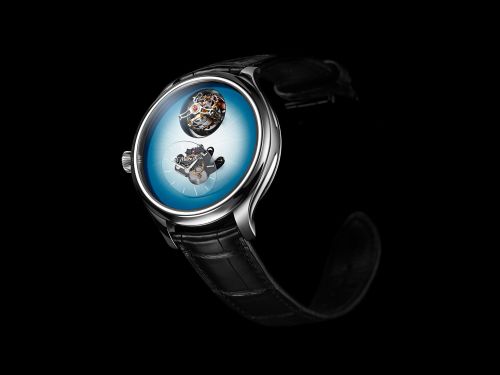
The H. Moser & Cie x MB&F Endeavour Cylindrical Tourbillon was introduced in 2020. The result of a collaboration with MB&F, it blends elements of H. Moser & Cie with the three-dimensional movement architecture typical of MB&F. It is made in four limited editions of 15 pieces each, with Funky Blue, Burgundy, Ice Blue, or Off White dials.
H. Moser & Cie. has borrowed from MB&F the concept of three-dimensional movements, a strong element of the Geneva Maison’s identity, protected by a sapphire dome and featuring a one-minute flying tourbillon that rises above the main dial through a ventricular opening appearing at 12 o’clock. Benefiting from the expertise of its sister company Precision Engineering AG, H. Moser & Cie. has equipped its tourbillon with a cylindrical balance spring, the same as that developed by Precision Engineering AG for MB&F’s LM Thunderdome. Invented in the 18th century, the cylindrical balance spring is reminiscent of a worm- or corkscrew, rising perpendicularly around the upper rod of the balance staff. Commonly used in historical marine chronometers at the time, it offers the advantage of developing concentrically, and therefore geometrically, since it works perfectly along the axis of its pivots. This gives it a significant advantage over the flat balance spring, whose opposite ends tend to exert forces on the pivots, despite the Philips or Breguet terminal curves which were specifically developed to partially correct the non-concentric opening of the balance spring. Fitted with a Breguet overcoil at both attachment points, the cylindrical balance spring reduces pivot friction and greatly improves isochronism. Due to its specific shape, the cylindrical balance spring is far more difficult to produce and takes ten times longer to make than a traditional balance spring.